$\newcommand{\v}[1]{{\mathbf #1}}$
Multivariate differentiation
We start by recalling the univariate case: A function
$f:{\mathbb R}\rightarrow{\mathbb R}$ is called differentiable at some $a$, if
$$\lim_{x\rightarrow a} \frac{f(x)-f(a)}{x-a}\mbox{ exists finitely.}$$
If this limit is called $m$, then this can be recast in the geometrically more appealing way as
$$\exists m\in{\mathbb R}~~ \lim_{x\rightarrow a}\frac{f(x)-\{f(a)+m\cdot(x-a)\}}{x-a} = 0.$$
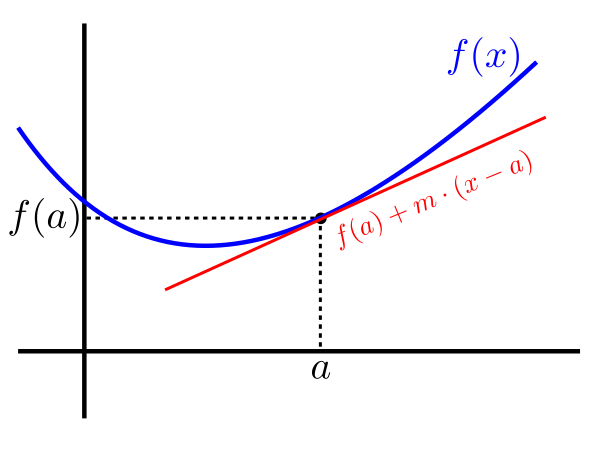
This is geometrically more appealing because you can think of this as $f(x)-f(a)\approx m\cdot(x-a),$ i.e., near $a$
the graph of $f$ looks like the line passing through $(a,f(a))$ with slope $m.$
The red tangent is almost indistinguishable from the blue curve near $(a,f(a)).$
This immediately generalises to $f:{\mathbb R}^n\rightarrow{\mathbb R}^m$ as follows.
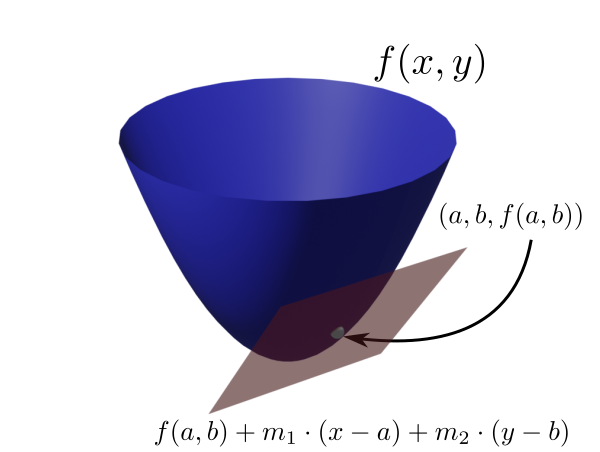
The situation for $f:{\mathbb R}^2\rightarrow{\mathbb R}$ is illustrated below.
The red tangent plane is almost indistinguishable from the blue surface near the dot.
Such a matrix $M$ (if it exists) may depend on $\v a,$ and will be unique, and its $(i,j)$-th
entry will be given by
$$m_{ij} = \frac{\partial f_i}{\partial x_j},$$
where $f_i$ is the $i$-th component of $f.$