Suppose that you have a function $f:{\mathbb R}^n\rightarrow{\mathbb R}^m.$ Then we
say that it is differentiable at some $\v a\in{\mathbb R}^n$ if
locally at $\v a$ the function may be "well approximated" by an
(affine) linear function passing through $(\v a, f(\v a)).$ Such a
function has the form
$$
g(\v x) = f(\v a) + D (\v x -\v a),
$$
where $D$ is a $m\times n$ matrix.
This
linear function is what we call the tangent if $m=n=1$ and the
tangent plane if $m=1,~n=2.$
This $D$ is
called the derivative of $f$ at $\v a.$ More commonly,
it is also called the Jacobian of $f$ at $\v a.$
If $m=1$ and $n>1$ then it is often denoted
by $\nabla f$ and called "grad $f$".
If you are curious about what is meant by "well approximated",
then here it is:
$$
\frac{f(\v x)-g(\v x)}{\|\v x - \v a\|}\rightarrow \v 0\mbox{ as } \v x\rightarrow\v a.
$$
The $\|\cdots\|$ is the length in ${\mathbb R}^n.$
Check that
for $n=1$ this is same as our familiar concept of differentiation.
The derivative of $f:{\mathbb R}^n\rightarrow{\mathbb R}^n$ at any given $\v
a\in{\mathbb R}^n$ is an $m\times n$ matrix $D.$
Its $(i,j)$-th entry is given by
$$
\frac{\partial f_i}{\partial x_j} (\v a).
$$
EXAMPLE:
If $f(x_1,x_2,x_3) = 4x_1x_2 - x_3^2,$ then direct
computation shows
$$
\nabla f = (4x_2, 4x_1, -2x_3).
$$
If
$f:{\mathbb R}^n\rightarrow{\mathbb R}$ is of the form
$$
f(\v x) = \v x' M \v x
$$
for some symmetric matrix $M,$ then
$$
\nabla f = 2\v x' M.
$$
This is the formula we have used in the soap film example.
Just like the familiar 1-dim derivative, the higher dimensional
derivatve also vanishes if $f$ attains a local max/min (for $m=1$). We
also have an analogous second order derivative check, but we
shall not go into that here.
Let $f:{\mathbb R}^m\rightarrow{\mathbb R}^n$ and $g:{\mathbb R}^n\rightarrow{\mathbb R}^p$ be both
differentiable with derivatives $D_f$ and $D_g,$
respectively. Let $h:{\mathbb R}^n\rightarrow{\mathbb R}^p$ is defined as $h =
g\circ f,$ then $h$ must be differentiable with
derivative at any $\va\in{\mathbb R}^n$ given by
$$
D_h = D_g( f(\v a)) D_f(\v a).
$$
For a function $f:{\mathbb R}^m\rightarrow{\mathbb R}^n$ that is differentiable at
some $\v a\in{\mathbb R}^n, $ we know that $f$ is well
approximated by the affine linear function
$$
g(\v x) = f(\v a) + D (\v x -\v a),
$$
where $D$ is the derivative of $f$ at $\v a.$ This
is called the 1st order Taylor approximation of $f.$ Under
suitable assumptions (related to existence and continuity of the second
partial derivatives of $f$), the error involved in this
approximation is of quadratic order.
If $f:{\mathbb R}^2\rightarrow{\mathbb R}$ is differentiable at
some $(x_0,y_0)$ then the tangent plane is given by
$$
z = f(x_0,y_0) + f_1(x_0,y_0)(x-x_0) + f_2(x_0,y_0)(y-y_0),
$$
where $f_i$ is the partial derivative of $f$
w.r.t. the $i$-th argument.
In particular, the partial derivatives must exist if $f$ is differentiable.
However, the converse is not true. It is possible that the
partial derivatives exist at some $(x_0,y_0)$ (and so the
above plane is well defined), but still $f$ is not
differentiable there. Thus, even if the plane exists, it need not
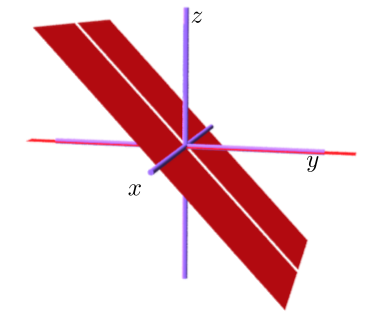
be the tangent plane. One such example is given by the function
$$
f(x,y) = \left\{\begin{array}{ll}-y&\text{if }x\neq 0\\0&\text{if }x=0\\\end{array}\right..
$$
The graph is shown below:
Not differentiable at $(0,0)$
Here $f_1(0,0) = f_2(0,0) = 0,$ and so the plane is just
the $xy$-plane, but clearly it is not tangent to the
surface.
Comments
To post an anonymous comment, click on the "Name" field. This
will bring up an option saying "I'd rather post as a guest."