 |
|---|
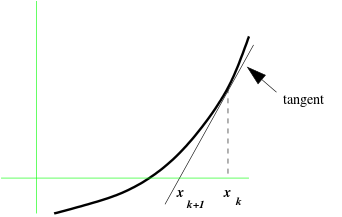
| Approximating $f(x)$ by the tangent at $x_k$ |
| Last updated on: SUN MAR 28 IST 2021 |
|
|---|
| Approximating $f(x)$ by the tangent at $x_k$ |
EXAMPLE:
Let us solve $\cos(x)=x$ using Newton-Raphson method starting with
$x_0=1.$ Here $f(x) = \cos(x)-x,$ and hence $f'(x) =
-\sin(x)-1.$ So the Newton-Raphson iteration is
$$
x_{k+1} = x_k + \frac{\cos(x_k)-x_k}{\sin(x_k)+1}.
$$
Let's convert it to R code:
x = 0
( x = x + (cos(x)-x)/(sin(x)+1) )
The outermost parentheses in the second line causes R to print
the new value of x at each step. Simply repeat this
line (by hitting the up cursor key followed by enter repeatedly)
to perform the iterations.
k      x
-------------
1   0.7503639
2   0.7391129
3   0.7390851
4   0.7390851
We already see convergence.

EXERCISE: Solve using the Newton-Raphson method:
EXERCISE: Write an R function:
NR = function(f, d, x0, n) {
  ...
}
to carry out $n$ steps of NR iterations for the
equation $f(x) = 0$ where $d(x)$ is the derivative
of $f(x).$ Here $x_0$ is the initial value.
f
and d are both functions. Just to get you stated
here is a function to compute $f(x)+g(x)$ at $x = x_0:$
plus = function(f,g,x0) {
  f(x0) + g(x0)
}
Use it like
plus(sin, exp, 1.3)
sin(1.3) + exp(1.3)
EXAMPLE:
Let us solve the system
$$\begin{eqnarray*}
xy+x^2-y^3-1 = 0\\
x+2y-xy^2 -2 =0
\end{eqnarray*}$$
Here $f_1(x,y) = xy+x^2-y^3-1$ and $f_2(x,y) = x+2y-xy^2 -2.$ So
the Jacobian matrix is
$$
D\ff(\xx) = \left[\begin{array}{ccccccccccc}y+2x & x-3y^2 \\
1-y^2 & 2-2xy
\end{array}\right]
$$
This has inverse given by
$$
(D\ff(\xx))^{-1} = \frac{1}{(y+2x)(2-2xy)-(x-3y^2)(1-y^2)}
\left[\begin{array}{ccccccccccc}2-2xy & 3y^2-x\\
y^2-1 & y+2x
\end{array}\right]
$$
Let's try to code this up in R. It will help if we employ vector
notation here. Thus, we shall use a single parameter to denote
the vector $(x,y).$
f = function(val) {
  x = val[1]
  y = val[2]
  c(x*y+x^2-y^3-1, x+2*y-x*y^2-2)
}
We have not used any explicit return this time. By
default, an R function always returns the value of its last
line. The c function creates a vector.
The following table shows a few sample iterations.
D = function(val) {
  x = val[1]
  y = val[2]
  matrix(c(y+2*x,1-y^2, x-3*y^2, 2-2*x*y), 2, 2)
}
The matrix function expects its entries
column-by-column. No need to invert the matrix ourselves. For a
non-singular matrix A and a vector b,
the expression solve(A,b) computes $A ^{-1} b$
in R.
Thus, the R version of the NR iteration becomes
val = c(0.34, 0.5)
( val = val - solve(D(val), f(val)) )
A sample output is given below.
n    x             y
-------------------------------------
0   0.34         0.5
1   1.0896157    0.6101134
2   0.8689638    0.9595518
3   0.9842601    0.9682277
4   0.9902055    0.9854784
5   0.9951545    0.9927297
6   0.9975793    0.9963689
7   0.9987903    0.9981854
8   0.9993953    0.9990929
9   0.9996977    0.9995465
10  0.9998489    0.9997733
11  0.9999244    0.9998866
12  0.9999622    0.9999433
13  0.9999811    0.9999717
14  0.9999906    0.9999858
15  0.9999953    0.9999929
16  0.9999976    0.9999965
17  0.9999988    0.9999982
18  0.9999994    0.9999991
19  0.9999997    0.9999996
20  0.9999999    0.9999998
Obviously we are converging to the solution $x=1,y=1.$
Here the $D$ matrix never became singular. Various
modifications of the $D$ matrix has been suggested
if it becomes
singular at some point during the iterations. These variations
are collectively called quasi-Newton-Raphson
iterations. Most softwares actually use such an algorithm,
when they claim to use Newton-Raphson method.
For $n=2$ it was easy to invert the matrix analytically. For higher
dimensions we should not explicitly invert the Jacobian matrix. Instead,
we should solve the system
$$
(D\ff(\xx_n)) \yy= \ff(\xx_n)
$$
for $\yy$ at each step. We shall learn such solution techniques in the next page.
EXERCISE: Solve using the Newton-Raphson method: $$\begin{eqnarray*} \sin xy + e^y & = & 7.10964\\ (x+y)^2 - \cos(xy^2) & = & 24.1561 \end{eqnarray*}$$
EXERCISE:
Write NR solver for a general nonlinear system in R like this:
NR2 = function(f, d, x0, n) {
  ...
}
Here $f:{\mathbb R}^n\rightarrow{\mathbb R}^n$ and $d:{\mathbb R}^n\rightarrow {\mathbb R}^{n\times n}$
gives its derivative (Jacobian) matrix. No need to check
nonsingularity.
 |
|---|
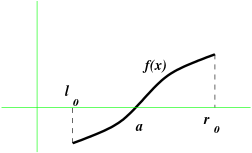
| $f(x)$ has a zero at $a$ |
EXAMPLE:
Let us apply the bisection method to solve the equation $\cos(x)=x.$
This is same as finding the zero of
$$
f(x) = \cos(x)-x.
$$
It is easy to see that $f(0) = 1$ and $f(\frac{\pi}{2}) =
-\frac{\pi}{2}.$ Since these have opposite signs we can start the
bisection method with
$$
l_0=0~~~\mbox{ and }~~~ r_0 = \frac{\pi}{2} = 1.5708.
$$
Our first guess is
$$
m_0 = \frac{l_0+r_0}{2} = 0.7854.
$$
It will help to write a little R code to proceed further.
l = 0
r = pi/2
f = function(x) cos(x) - x
for(i in 1: 20) {m = (l+r)/2; if(f(m)*f(l) < 0) {r= m} else {l = m}; cat(l, r,'\n')}
These lines introduce two new features of R. First, for a
function consisting of a single expression, the enclosing braces
are optional. Second, we can use for-loops in R.
k left         right       mid
------------------------------
0    0         1.5708   0.7854
1    0         0.7854   0.3927
2    0.3927    0.7854   0.5890
3    0.5890    0.7854   0.6872
4    0.6872    0.7854   0.7363
5    0.7363    0.7854   0.7609
6    0.7363    0.7609   0.7486
7    0.7363    0.7486   0.7424
8    0.7363    0.7424   0.7394
9    0.7363    0.7394   0.7378
We proceed until the interval is short enough, i.e., $(r_k-l_k)< \epsilon$ for some specified $\epsilon.$ In the above table we have stopped once the $l_k$ and $r_k$ are equal up to the first two decimal places. Thus, we see that the answer is 0.74 up to the first two decimal places.
EXERCISE:
Write an R function like
bis = function(f, l, r, n) {
  ...
}
to apply bisection method to a function $f(x)$. Your
function should stop with an error message if $f(l)$
and $f(r)$ are not of opposite signs. The R function
stopifnot may help here.
EXERCISE:
Use the bisection method to solve $2e^x-2x-3 = 0$ for $x\in(0,2).$
PROJECT:
A certain trait in rabbits is controlled by a pair of alleles, $a$ and $A.$ Each rabbit receives one of these
from the father and another from the mother. Thus, the possible pairs are $aa,$ $aA$ and $AA$ (order is
immaterial). The probability that a parent gives an $a$ to the offspring is $p$ (unknown). So the probability
of an $A$ is $q = 1-p.$ The father's contribution is independent of the mother's, and so the probabilities of
$aa,$ $aA$ and $AA$ in the offspring are, respectively, $p^2,$ $2pq$ and $q^2.$ Our
aim is to estimate $p.$ Unfortunately, it is impossible to detect the pair an offspring has. It is only possible to
detect if an offspring has at least one $A$, i.e., whether $aa$ or $\{aA, AA\}.$ The probabilities are,
respectively, $p^2$ and $q^2+2pq.$ In a random sample of 100 offsprings, only 23 are without any $A.$
The probability of this is
$$L(p)=p^{46}\big(q^2 +2pq\big)^{77}.$$
The value of $p\in(0,1)$ for which this is the maximum is called the maximum likelihood estimator of $p.$ Find
it.
PROJECT:
The file data.txt has $n=996$ random numbers that are generated from the density
$$f(x; p, a) = \frac{ a^p}{\Gamma(p)} x^{p-1}e^{-a x},\quad x>0$$
for unknown constants $p, a > 0.$ The principle of maximum likelihood estimation suggests estimating
$p,a $ by maximising
$$L(p,a) = \prod_{i=1}^n f(x_i; p,a),$$
where $x_1,...,x_n$ are the data in the file. Perform this estimation, and check your answer
graphically by overlaying the graph of $f(x;p,a)$ on the histogram of the data.
gamma, dgamma and
digamma useful here.]